
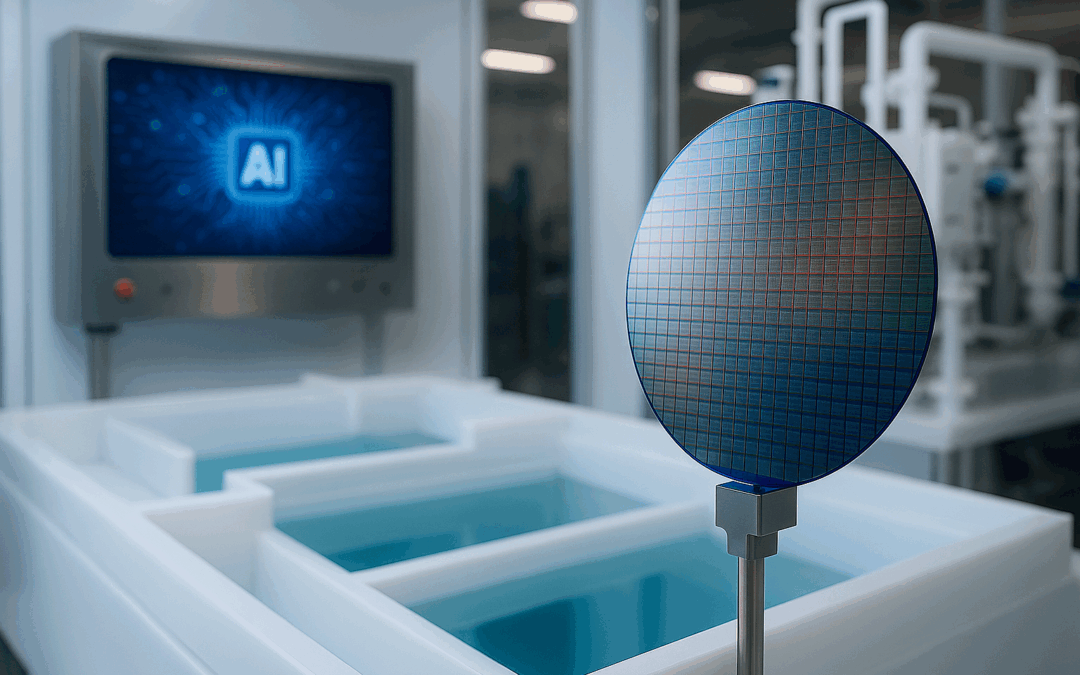
The rapid acceleration of artificial intelligence (AI) technology over the past few years has been nothing short of extraordinary. From machine learning algorithms revolutionizing healthcare diagnostics to large language models transforming customer service and creative industries, AI’s potential is only beginning to be realized. At the heart of this explosive growth, however, lies a critical piece of infrastructure that is often overlooked: the semiconductor industry—and more specifically, the role of wet benches in chip manufacturing.
Wafer Process Systems, based in San Jose, CA, plays a pivotal role in enabling this AI-driven future by designing and manufacturing wet process equipment essential for semiconductor production. Wet benches are used in ultra-clean environments to chemically process silicon wafers during chip fabrication, ensuring that every transistor—sometimes billions on a single chip—functions flawlessly.
Why Cleanliness Equals Intelligence
AI models require immense computational power, which in turn demands extremely dense, efficient, and clean chips. Every AI chip, whether used in data centers or embedded in smart devices, is the product of a rigorous fabrication process. Wet benches are integral to key steps such as RCA cleaning, oxide etching, and photoresist stripping—all of which remove microscopic contaminants that can destroy chip functionality.
Without these ultra-clean processes, the yield of usable chips would plummet. That means fewer chips, higher prices, and delayed advancements in AI. The purity and consistency achieved through wet processing directly impact the speed and reliability of AI hardware, from NVIDIA’s GPUs to custom-designed AI accelerators.
Scalability and Yield in the AI Era
As AI workloads grow more complex, requiring larger models and faster training times, chip designers are pushing the boundaries of lithographic precision and layering. Wet benches support this drive by enabling multi-layer wafer processes with exceptional uniformity and repeatability. This allows fabs to scale production while maintaining high yield rates—critical for meeting the soaring global demand for AI chips.
Wafer Process Systems contributes to this mission by engineering custom wet benches tailored to a fab’s specific processes, whether for research and development or high-volume production. Their systems integrate advanced automation, safety protocols, and precision fluid controls that are essential for producing next-generation AI semiconductors.
Looking Ahead: AI’s Future Depends on Wet Process Innovation
The future of AI lies in more than just smarter algorithms—it requires innovations at the materials and fabrication level. As chip architectures evolve, particularly toward 3D stacking and novel substrates, wet processing techniques will also need to adapt. This includes enhanced chemical formulations, new wafer handling technologies, and tighter environmental controls.
Companies like Wafer Process Systems are already preparing for this next phase by innovating their wet bench designs to handle increasingly demanding semiconductor requirements. Their contributions will help power everything from autonomous vehicles to edge AI applications in smart cities.
In a world racing toward smarter technology, it’s easy to overlook the foundational equipment that makes it all possible. But without the meticulous cleaning and preparation provided by wet benches, AI wouldn’t just slow down—it might never have taken off in the first place.